

How to Choose the Right Outex Front Glass Port for Your Lens
Apr 23, 2023
Choosing the right Outex front glass port starts with your lens and the images you want to create. For a flat port, match your lens filter thread size. For a dome port, choose the appropriate adaptor or clamp for your lens. This guide explains both routes, including lenses without accessible filter threads, prime and zoom compatibility, and when a dome offers the greatest optical benefit.
3-Step Port Selection Guide
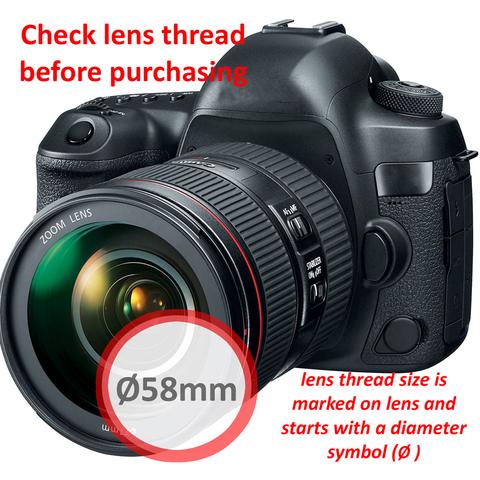
- Find your lens filter thread size — it's printed on your lens or lens cap with the symbol ⌀ (e.g. ⌀77 means 77mm). It is not your focal length or zoom range.
- Choose your port type — for a flat port, match that number to your Outex front port size. Outex supports all standard filter thread sizes from 49mm to 105mm. A threaded lens can also use a dome port with the appropriate dome adaptor; a filter thread does not limit you to flat ports.
- No accessible filter thread? — If your lens has a curved front element, lacks front filter threads, or has a built-in, nonremovable hood that prevents a flat port from attaching, use an Outex Dome Port with the appropriate lens-specific clamp. Check the lens design rather than assuming every fisheye or hooded lens has the same attachment requirements.
How to Find Your Filter Thread Size
The filter thread size is the diameter of the front of your lens in millimetres. It is always marked with the ⌀ symbol and is usually found:
- Printed on the front ring of the lens barrel
- Printed on the inside of the lens cap
- Listed in your lens manual or manufacturer's spec sheet
Important: The filter thread size is completely separate from your focal length or zoom range. A 24-105mm lens has a focal length range of 24–105mm, but its filter thread size might be 77mm — these are different measurements.
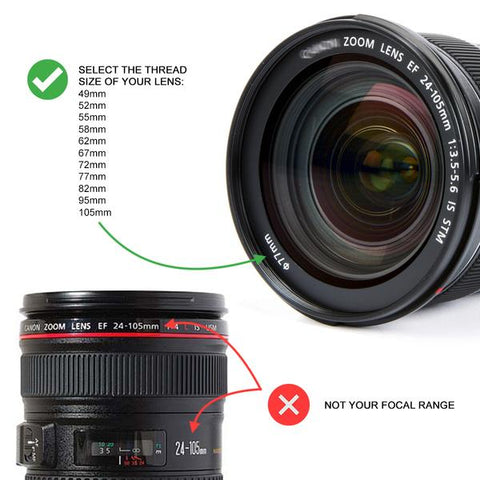
Example: focal length = 24–105mm, filter thread size = 77mm. You would order the Outex 77mm front port.

Why Outex Ports Are Sized to Filter Thread Diameter
Outex flat front glass ports are engineered to match industry-standard filter thread diameter sizes for two key reasons:
- Optimal optical positioning — the port threads directly onto your lens, just like a UV filter or polarizer. It becomes one with the lens, moving with it at all focal lengths. This eliminates vignetting, reflections, and the refraction issues common in housings where the port floats independently of the lens.
- Perfect fit every time — because the port anchors to the lens thread, there is no guesswork about alignment. The optical glass is always positioned correctly for that specific lens.
Outex supports all standard filter thread sizes from 49mm to 105mm. All front ports are interchangeable across all Outex cover sizes — you can purchase multiple ports and use them with any cover.
Why Optical Glass — Not Acrylic or Plastic
All Outex front glass ports use professional-grade optical glass, not acrylic or polycarbonate like most other underwater housings. The reasons are the same as why your camera lens uses glass:
- Superior image sharpness and clarity — glass maintains the optical standards of your lens itself.
- True color accuracy — no distortion or color shift introduced by the port material.
- Professional durability — glass is far more scratch-resistant than acrylic and performs reliably in demanding environments.
Photographers and filmmakers worldwide trust Outex because the glass ports maintain the same optical standards used in professional lenses and filters.

Two Outex Pro Kit systems showing flat port (left) vs. dome port (right) side by side.
Using Step-Up Rings
If you have a lens with a smaller filter thread than the port you own, you can use a step-up ring to bridge the gap. The rule is simple:
Always go larger, never smaller. Use a step-up ring to fit a smaller-thread lens into a larger port (e.g. a 77–82mm step-up ring with an 82mm Outex port for a 77mm lens). Never use a step-down ring to fit a larger-thread lens into a smaller port — this will cause significant vignetting, especially with wide-angle lenses.
Note that step-up rings may introduce some vignetting even when used correctly, particularly with wide-angle lenses, because they add physical distance between the lens and port. Using the correctly matched port size always delivers the best results.
When installing step-up rings, filters, or polarizers, do not over-tighten them onto the Outex front port — follow the same care you would with any lens accessory. See the Installation guide for full instructions.
Lenses Without Accessible Filter Threads: Use a Dome Port
Some lens designs prevent a flat front port from attaching directly:
- Fisheye lenses without front filter threads
- Lenses with curved front elements that cannot accept a flat front port
- Hooded lenses without a filter thread
- Lenses with built-in, nonremovable hoods that obstruct flat-port attachment
For these lenses, an Outex Dome Port provides the attachment route. Both Outex domes — the Dome 120mm and Dome 180mm — work with threaded lenses via adaptors or unthreaded lenses via clamps. The dome is positioned and secured to the lens for optimal optical results and stability inside the cover.
- Dome adaptors — attach to a lens's front filter threads; choose the size that matches your lens.
- Dome clamps — secure around the lens barrel when front threads are unavailable or unsuitable; choose the clamp for that lens's barrel dimensions.
Does a threaded lens need a dome?
Not necessarily. A lens with accessible filter threads can use a matching flat port, or an Outex dome with the appropriate adaptor. A dome is not reserved for lenses that cannot accept a flat port: choose it for the images you want, especially wide-angle underwater and split-level compositions. Longer-focal-length lenses can also use a dome; they do not require a flat port to avoid dome-introduced distortion.
Can I use a dome with prime and zoom lenses?
Yes. Outex domes support both fixed-focal-length (prime) lenses and variable-focal-length (zoom) lenses. Select the adaptor or clamp for the specific lens, not simply its focal length or camera brand. For a zoom lens, confirm that the cover and fitting accommodate its movement. The dome’s optical benefit changes gradually with field of view, but Outex domes do not introduce distortion at any focal length.
Why does focal length matter?
Outex domes work with any lens using the appropriate dome adaptors or clamps and do not introduce distortion at any focal length. Their curved shape is designed to complement the broad field of view of wide-angle lenses, which derive the greatest optical benefit from the dome.
As focal length increases and the field of view narrows, the lens looks through a smaller area near the center of the dome, gaining less benefit from its curved surface. The benefit therefore diminishes gradually as focal length increases. There is no recommended focal-length number or cutoff, and diminishing benefit does not mean added distortion.
Water clarity, lighting, shooting distance, and the lens’s own optical characteristics can affect the image. These factors should not be confused with distortion introduced by the port being used. For the optical explanation and dome-size tradeoffs, see the Dome Ports vs. Flat Ports guide.
Does an Outex dome introduce distortion with longer-focal-length lenses?
No. Outex domes do not introduce distortion at any focal length. Wide-angle lenses gain the greatest optical benefit; that benefit gradually diminishes as focal length increases because the lens looks primarily through the center of the dome.
How Outex Dome Clamps Work — And Why the Dome Never Becomes Obsolete
The Outex dome itself is a precision optical instrument — and a long-term investment. The clamps and adaptors are what connect it to your specific lens, and this distinction is the key to understanding why the Outex system is so future-proof.
Metal construction. Built for precision and longevity.
All Outex dome clamps are machined from metal — not plastic. Metal ensures the clamp holds its shape and tension across thousands of uses, in saltwater, cold, heat, and pressure. It grips your lens barrel with consistent, calibrated force that plastic simply cannot maintain over time.
Adjustable travel for a perfect fit on any lens barrel.
Each clamp features approximately 1–2mm of adjustable travel. This engineered tolerance means a single clamp size can conform precisely to a range of lens barrel diameters — gripping cleanly without play or wobble. The dome stays locked in the correct optical position regardless of the exact barrel diameter within that range.
Every lens size. Every lens brand. Past, present, and future.
Outex manufactures clamps and adaptors in all sizes, matched to the full spectrum of lenses currently available — and continues to expand the range as new lenses come to market. This means:
- The dome you buy today works with every lens you own now.
- It will work with every lens you buy in the future.
- If a new lens comes out, the inexpensive clamp or adaptor is all you ever need to add.
The dome — the premium optical component — never needs to be replaced. Your investment is protected.
The smart economics of the Outex Dome system.
The dome itself is the significant purchase. The clamps and adaptors — which are the lens-specific components — are the affordable part. When you change lenses, add a lens, or upgrade your camera system entirely, you simply add the matching clamp or adaptor. You never replace the dome.
This is by design. Outex engineered the system so that lens compatibility is always available, always inexpensive, and never forces you to repurchase your optics.
One dome. Every lens. Forever.

For a full explanation of dome ports, how they work, and when to use them vs. flat ports, see the Dome Ports vs. Flat Ports guide.
Compatibility Summary
- All Outex front glass ports (flat and dome) are compatible with all Outex cover sizes.
- Flat ports and dome ports are interchangeable — you can own and use both.
- A lens with accessible filter threads can use a flat port or a dome with the appropriate adaptor.
- For lenses without usable front threads, including obstructive built-in hoods, choose the appropriate dome clamp.
- Domes support both prime and zoom lenses. Wide-angle lenses gain the greatest optical benefit, with gradually diminishing benefit as focal length increases. There is no numerical focal-length recommendation or cutoff, and Outex domes do not introduce distortion at any focal length.
- Additional ports can be purchased individually from the Parts page.
- Kits include one front port size of your choice — add more sizes as needed.
Ready to Order Your Front Port?
Once you know your filter thread size, you can purchase the matching front glass port individually from the Parts page, or as part of a complete kit from the Camera Kits section.